
AI Technology
Beyond the Prompt File: Why Safety AI Needs Architecture, Not Just Intelligence
The difference between answering safety questions and actually improving safety outcomes. An honest look at why generic LLMs fall short and what separates a true platform.
By Matthew Hart
CEO
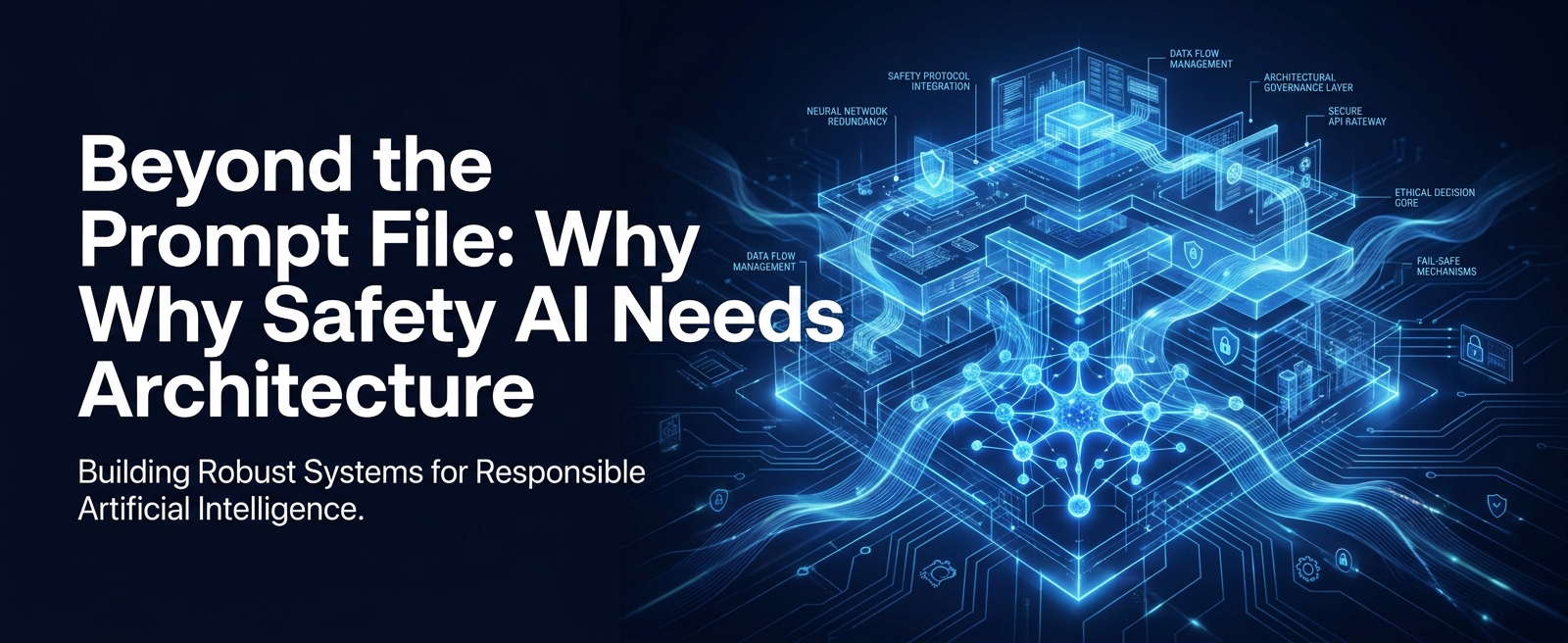
It's a fair question that comes up in almost every enterprise conversation: "Why not just use ChatGPT for this?"
Generic large language models are genuinely impressive. They can answer safety questions, draft incident reports, and explain regulations. But there's a meaningful gap between answering a safety question and actually improving safety outcomes. Understanding that gap is the difference between a tool and a platform.
The Honest Answer
A generic LLM is like having a very smart person who can read and think. A purpose-built safety platform is like having a team of specialists who know your industry, your regulations, your operations, and your history. One answers questions. The other changes outcomes.
The Benchmark Test: Proof That Wrappers Have Limits
In 2025, SoterAI built an independent safety AI benchmark called SAFE-Bench to answer a critical question: Is SoterAI actually better at safety reasoning than the underlying models it builds on?
The results are clear:
95.64%
SoterAI
Real Safety Tasks
87.14%
Claude
Underlying Model
86.36%
GPT
Underlying Model
The critical insight:
You can't outperform the underlying model if you're just wrapping it in a prompt. That gap exists because of architecture, training data, and domain specialization—not because we're using a better version of the same thing. This is the clearest proof that SoterAI is not a wrapper.
Architecture: Systems Engineering, Not Prompt Engineering
This is where the real difference emerges. SoterAI runs 50 specialized sub-agents in parallel.
Here's how parallel processing transforms safety analysis:
- When you upload a policy document, one agent analyzes each chapter simultaneously
- When you submit a hazard report, different agents handle regulatory cross-reference, industry standard alignment, and internal policy matching in parallel
- A single LLM call—no matter how well-prompted—processes one thing at a time, linearly
This is systems engineering. The difference shows up in accuracy, speed, and the ability to cross-reference across large document sets without losing context. A generic LLM can answer "What does OSHA say about fall protection?" A platform can answer "Here's what OSHA says, here's what your industry standard requires, here's what your company policy specifies, and here's where they conflict" in 30 seconds.
Data Depth: Seven Years of Enterprise Operations
Training data has a cutoff date. SoterAI has operational data that's continuously updated.
Training data with a cutoff date
General knowledge across all industries
No access to enterprise-specific patterns
Informed guesses at best
100,000+ OSHA violations indexed
15,000+ inspections reviewed
200+ enterprises across real operations
10+ regulatory jurisdictions tracked
Seven years of enterprise safety data. Real patterns from real deployments. When a safety manager asks "What's the most common violation in our industry?" a generic LLM gives a general answer. SoterAI gives an answer based on what actually happened in 15,000 inspections. One is informed. The other is grounded in evidence.
Three-Level Compliance Architecture
Operate at Level 1 only, and only if the regulation is in their training data. No awareness of industry-specific standards or your company's operations.
Level 1: Regulations
OSHA, EPA, state regulations
Level 2: Industry Standards
ISO, ANSI, NFPA, industry-specific requirements
Level 3: Your Company
Internal policies, SOPs, automatically cross-referenced and conflict-flagged
This isn't a prompt. It's a knowledge graph that understands your business.
Beyond Text: Multi-Modal Safety
Generic LLMs process text. Platforms process how safety actually happens.
Workplace Photos
Upload a photo of a warehouse floor and get a hazard report in 30 seconds
Video Analysis
Submit a video of an ergonomic concern and receive REBA scoring and corrective guidance
Voice Capture
Incident reporting without typing, making documentation faster and more accessible
Enterprise Outcomes: The Numbers That Matter
A prompt file doesn't have a track record. A platform does.
53%
Average Injury Reduction
Across SoterAI customers
70%
EHS Admin Reduced
Blackmores Group results
5 hrs → 30 min
Meeting Prep Time
ICW Group optimization
11x ROI
In 8 Months
UFA achievement
These aren't marketing claims. They're documented results from real deployments across different industries and geographies.
Why This Question Actually Matters
"Could you just use ChatGPT for this?" is a useful question. It forces clarity about what a platform actually does and why it exists.
The answer isn't defensive. It's specific and measurable:
A generic LLM can answer safety questions. It's responsive, it's available, and for simple queries it works fine.
SoterAI improves safety outcomes. It leverages parallel processing, seven years of enterprise data, multi-level compliance intelligence, and multimodal analysis to deliver measurable, auditable results across complex safety operations.
For enterprises evaluating AI safety tools, that difference is everything.