
Platform Comparison
Soter vs SafetyCulture: Hazards to Controls vs Inspection Templates
Forms capture data. SoterAI drives the workflow.
SafetyCulture
SoterAI
Template-first: start with a form, fill it out section by section
Workflow-first: guided AI executes the job, records emerge as a by-product
No closed loop — action items sit separate from hazard records and controls
Every assessment closes to a hazard record, control owner, and verification
Generic AI with no knowledge of your business history or risk profile
Risk Intelligence built from your incidents, controls, and hazard data
Already using SafetyCulture? Think of it as a data source for SoterAI.
SafetyCulture is an excellent forms and inspection tool. Many teams continue using it to capture frontline data — and pipe that data directly into SoterAI, where it becomes part of your hazard records, controls, and Risk Intelligence. You do not have to choose one or the other on day one.
500+
Enterprise customers
7-day
Free trial, no credit card
Self-serve
Starter plan available
Trusted by safety teams at





SafetyCulture and SoterAI are often compared, but they solve safety differently. SafetyCulture is a fundamentally form-based platform: it presents forms, users fill them out section by section, with no AI support. SoterAI is a workflow-first agentic AI platform that understands what the user is trying to achieve and guides them through executing it: inspections, ergonomic assessments, policy reviews, hazard identification, incident reporting. Ergonomics is just one of many workflows. Both platforms cover the same broad EHS scope; what differs is whether you fill out forms or have a conversation.
The Difference
How SoterAI is built differently
SafetyCulture and other form-based EHS platforms
Fundamentally form-based: present forms, users fill them out manually, section by section, with no AI support
High friction: people dislike filling out forms, leading to incomplete, low-quality data capture
No Risk Intelligence: no ability to process historical incident, control, and hazard data into meaningful understanding of control effectiveness
Siloed systems: do not connect to other EHS, operational, HR, or business systems, so they only know what's been entered into them
No conversational or multimodal data capture: users must navigate forms and type responses manually
Generic AI at best: no contextual understanding of the specific business, its history, or its risk profile
Data capture is the destination: the workflow ends when the form is submitted, not when the control is verified
SoterAI
Agentic AI system: understands what the user is trying to achieve and guides them through executing it: inspection, assessment, policy review, hazard identification, any workflow
Data capture is a by-product of doing the work, not the goal itself; structured records emerge as a natural outcome of the guided workflow
Risk Intelligence: built from all historical incident, control, and hazard documentation. Not generic AI, but AI that truly understands the history, context, and risk profile of your specific organisation. Helps safety professionals answer the fundamental question: are our controls adequate, verified, and effective?
Connected: integrates with EHS, operational, HR, and other business systems. SoterAI understands the full context of the business, not just what's been entered into it
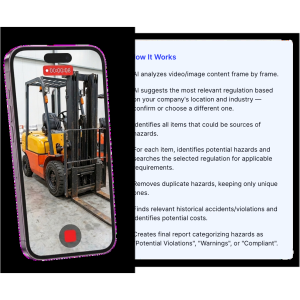
Conversational and multimodal: users talk to SoterAI or upload videos and photos. The AI processes and structures information into the record. The form is a review step before submission, not the data-entry method
Two-way coaching: SoterAI coaches users through the process, asking follow-up questions to capture richer, more complete data
Workflow-first: ergonomics is one of many workflows. SoterAI covers hazard assessments, policy reviews, incident reporting, inspections, and much more
The Question
Why teams compare these two
Search traffic for SafetyCulture alternative usually means one of three things. First, the team already owns SafetyCulture for inspections and wants stronger ownership after a finding is captured. Second, the team is shopping for one safety system and is comparing a template-led operating platform with a guided workflow platform. Third, the team wants records, hazards, controls, and verification to live in one loop instead of stopping at a completed checklist.
The honest answer is workflow ownership: decide which system owns the record, the control, and the verification step.
Honest Take
Where SafetyCulture still fits
SafetyCulture earned the inspection-template category. There are real scenarios where a form-led system remains the right tool.
Multi-site inspections at frontline scale
SafetyCulture runs 1 billion+ checks per year across 76,000+ organizations. If your program needs digitized inspections, audits, sensor checks, asset rounds, and lone-worker check-ins across hundreds of sites, the catalog and platform breadth is hard to match.
Frontline training and microlearning
The training module ships with AI-generated course creation, SMS and WhatsApp delivery, and built-in tracking. For onboarding, refresher training, and compliance-driven content, it is a working system.
Template-driven workflow at long-tail scale
SafetyCulture's library has 10,000+ templates spanning every industry. If your team rolls out new checks weekly, that catalog removes most of the lift.
SMB and self-serve entry point
Free tier covers up to 10 users with 5 active templates. For a single facility that just needs digitized checklists, the entry friction is minimal.
Where SoterAI Wins
Where SoterAI excels
SoterAI is built for work that should not start and end with a completed form.
Closed-loop control on hazards and risk
Inspection findings sit in a report. Hazards sit in a register, tied to a control owner, a due date, and a verification check. SoterAI supports ergonomic assessment, hazard identification, inspections, incident reporting, policy review, and other workflows. Each finding becomes a record. Each record can become a corrective action. The action is verified. This is the loop SafetyCulture leaves open.
Workflow-first safety management
SafetyCulture publishes operational metrics for reporting speed and compliance savings. SoterAI is built around the workflow signals safety leaders need after capture: which hazards were found, which controls were assigned, which actions are overdue, and whether reassessment shows the risk moved.
Phone photo and video capture inside a broader workflow
SoterAI uses phone photos, videos, voice, and follow-up questions to support inspections, hazard identification, ergonomic assessments, equipment checks, and other safety workflows. The capture step feeds the same hazards, records, controls, and verification layer.
Insurance and workers' comp angle
Insurance and workers' comp teams can use SoterAI to improve record quality, control ownership, and verification coverage across risk reviews. Results vary by workflow and rollout scope, so this page should not treat legacy customer metrics as SoterAI proof.
Hazards-to-controls operating system, not horizontal ops
SafetyCulture is broad workplace operations software. Soter stays focused on safety and risk work: hazard identification, inspections, assessments, incidents, corrective action, and verification. The focus matters when a Safety Professional needs to show which controls were assigned, owned, and checked after the work changed.

Ready to move beyond form-based safety?
Start a free 7-day trial or book a 30-minute fit call.
Comparison
Honest comparison table
Capability
SafetyCulture
Soter
Category
Workplace operations platform, inspection-ledHazards-to-controls operating systemInspection and checklist library
10,000+ templates across industriesBroad safety and risk templates, including environmental, insurance, hygiene, legal, contracts, and site operationsErgonomic risk workflows (RULA, REBA, NIOSH-style)
Not the primary inspection-template use caseGuided workflow with safety professional reviewHazard register with closed-loop controls
Partial — action items but no hazard-to-control loopYesWorkflow ownership after capture
Checklist action items, separate from a full hazard-to-control loopRecord, control owner, due date, and verification in one guided flowRisk Intelligence
Template and report dataUses safety history and business contextFrontline training module
YesNoLanguage and communication style
Localized inspection-template surfaceWorks in any language and adapts to the user's communication stylePublic pricing
Free tier, $24-29 per seat, enterprise customSelf-serve plus enterpriseFree trial
YesYesConversational and multimodal capture
Forms and checklist fieldsVoice, photos, videos, and follow-up questionsImplementation model
Self-serve through enterprise rolloutSelf-serve through enterprise rolloutBest fit
Operations teams running inspections at scaleSafety and risk teams moving hazards, records, controls, and verification into one guided workflowCategory
SafetyCulture
Workplace operations platform, inspection-led
Soter
Hazards-to-controls operating system
Inspection and checklist library
SafetyCulture
10,000+ templates across industries
Soter
Broad safety and risk templates, including environmental, insurance, hygiene, legal, contracts, and site operations
Ergonomic risk workflows (RULA, REBA, NIOSH-style)
SafetyCulture
Not the primary inspection-template use case
Soter
Guided workflow with safety professional review
Hazard register with closed-loop controls
SafetyCulture
Partial — action items but no hazard-to-control loop
Soter
Yes
Workflow ownership after capture
SafetyCulture
Checklist action items, separate from a full hazard-to-control loop
Soter
Record, control owner, due date, and verification in one guided flow
Risk Intelligence
SafetyCulture
Template and report data
Soter
Uses safety history and business context
Frontline training module
SafetyCulture
Yes
Soter
No
Language and communication style
SafetyCulture
Localized inspection-template surface
Soter
Works in any language and adapts to the user's communication style
Public pricing
SafetyCulture
Free tier, $24-29 per seat, enterprise custom
Soter
Self-serve plus enterprise
Free trial
SafetyCulture
Yes
Soter
Yes
Conversational and multimodal capture
SafetyCulture
Forms and checklist fields
Soter
Voice, photos, videos, and follow-up questions
Implementation model
SafetyCulture
Self-serve through enterprise rollout
Soter
Self-serve through enterprise rollout
Best fit
SafetyCulture
Operations teams running inspections at scale
Soter
Safety and risk teams moving hazards, records, controls, and verification into one guided workflow
Rollout
Migration considerations
Teams can layer SoterAI first, then decide where each workflow should live.
A typical sequence when adding SoterAI to a SafetyCulture stack:
- 01
Keep SafetyCulture for long-tail inspection rounds, audits, and training while you prove SoterAI on higher-value workflows.
- 02
Add SoterAI at one site for ergonomic assessment, hazard identification, incident reporting, or a policy-review workflow.
- 03
Wire findings into SoterAI records with corrective actions and owners. This is the closed-loop step neither form action items nor a spreadsheet covers cleanly.
- 04
After 60 to 90 days, review which workflows live in which tool. The decision should follow record quality, control ownership, verification speed, and frontline adoption.
- 05
For teams with a workers' comp lens, add Soter's loss-control reporting export to share with the carrier or insurer.
A full replacement makes sense when the organization wants to rebuild safety work around guided execution instead of template completion. A partial rollout makes sense when SafetyCulture still owns useful checklist libraries but not the higher-value control workflow.
Outcomes
Workflow outcomes to measure
Coverage
More work captured
Track how many assessments, hazards, incidents, and policy reviews are completed without waiting for a specialist to rebuild the form or chase missing fields.
Quality
Richer records
Conversational and multimodal capture helps teams collect the context, images, video, and follow-up answers that static templates often miss.
Closure
Controls owned
Every serious finding should have an owner, a due date, and a verification path instead of sitting as a completed checklist item.
Learning
Risk Intelligence
Historical incidents, hazards, controls, and business context become searchable evidence for deciding whether controls are adequate and effective.
Built for teams that want safety work to move from form completion to verified control.
FAQ
Frequently asked questions
Compare Soter with other platforms:
Ready to see measurable loss reduction?
Book a short demo and see how SoterAI helps your clients work safer, renew easier, and save on premiums.
Loading form...
Soter is developed by Soter. We are not affiliated with SafetyCulture. This page is provided for independent comparison purposes based on publicly available information as of April 2026. All trademarks are the property of their respective owners.