Platform Comparison
SoterAI vs TuMeke: Video Ergonomic Assessment That Closes the Loop
The hazards-to-controls operating system, not a score in a dashboard
TuMeke
SoterAI
Scores stay in a dashboard — no connection to hazard records or corrective actions
Every score wires into a hazard register, control owner, and OSHA hierarchy of controls
Ergonomics-only: RULA, REBA, and NIOSH scoring from video, nothing more
Ergonomics is one workflow among many — incidents, inspections, and policy reviews in one loop
No Risk Intelligence — no context from your historical incidents or control data
Risk Intelligence learns from your work history so future assessments reflect real organisational risk
500+
Enterprise customers
7-day
Free trial, no credit card
Self-serve
Starter plan available
Trusted by safety teams at



The Difference
Why teams choose SoterAI over TuMeke
TuMeke
Video ergonomic assessment using computer vision joint tracking. RULA, REBA, and NIOSH scoring with AI-generated recommendations. A focused scoring tool.
SoterAI
The hazards-to-controls operating system. Video assessment, hazard register, corrective-action ownership, OSHA hierarchy of controls, incident linkage. The whole loop, not just the score.
Compare SoterAI with other platforms:
The Difference
How SoterAI is built differently
TuMeke and ergonomic scoring tools
Focused on video-based ergonomic scoring and intervention modeling
Strong when the job is to score posture and movement from video
The operational gap is what happens after the score: owner, control hierarchy, due date, and verification
Task improvement can live as a recommendation instead of a managed workflow with accountable follow-up
Other safety workflows, such as hazards, incidents, near-misses, and audit prep, still need a connected operating layer
SoterAI
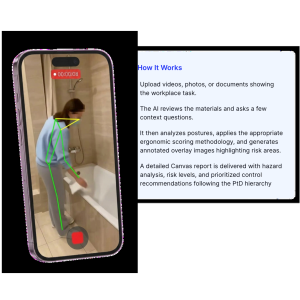
Agentic AI system: understands what the user is trying to achieve and guides them through executing it: inspection, assessment, policy review, hazard identification, any workflow
Data capture is a by-product of doing the work, not the goal itself; structured records emerge as a natural outcome of the guided workflow
Risk Intelligence: built from all historical incident, control, and hazard documentation. Not generic AI, but AI that truly understands the history, context, and risk profile of your specific organisation. Helps safety professionals answer the fundamental question: are our controls adequate, verified, and effective?
Connected: integrates with EHS, operational, HR, and other business systems. SoterAI understands the full context of the business, not just what's been entered into it
Conversational and multimodal: users talk to SoterAI or upload videos and photos. The AI processes and structures information into the record. The form is a review step before submission, not the data-entry method
Two-way coaching: SoterAI coaches users through the process, asking follow-up questions to capture richer, more complete data
Workflow-first: ergonomics is one of many workflows. SoterAI covers hazard assessments, policy reviews, incident reporting, inspections, and much more
Comparison
Comparison table
Capability
TuMeke
SoterAI
Video-based ergonomic scoring
RULA, REBA, NIOSH via computer vision joint trackingRULA, REBA, and NIOSH-style workflows with safety professional reviewHazard register and closed-loop controls
Public surface centers on ergonomic scoring, recommendations, and intervention modelingEvery serious finding can become an owned hazard recordOSHA hierarchy of controls applied
Ergonomic recommendations and intervention guidanceEngineering, administrative, PPE classified per findingTask improvement, ownership, and verification
PartialTask redesign options, owner, due date, verification on next assessmentIncident and near-miss linkage
Not positioned as the primary public workflowYes, linked into one record graphWorkflow outcomes at scale
Published customer-average injury reduction claimCoverage, record quality, control ownership, overdue actions, and verified reassessmentPhone-video assessment start
Video scoring focusIncludedPricing transparency
Free trial, per-seat price not publicSelf-serve Starter plan, plus EnterpriseVideo-based ergonomic scoring
TuMeke
RULA, REBA, NIOSH via computer vision joint tracking
SoterAI
RULA, REBA, and NIOSH-style workflows with safety professional review
Hazard register and closed-loop controls
TuMeke
Public surface centers on ergonomic scoring, recommendations, and intervention modeling
SoterAI
Every serious finding can become an owned hazard record
OSHA hierarchy of controls applied
TuMeke
Ergonomic recommendations and intervention guidance
SoterAI
Engineering, administrative, PPE classified per finding
Task improvement, ownership, and verification
TuMeke
Partial
SoterAI
Task redesign options, owner, due date, verification on next assessment
Incident and near-miss linkage
TuMeke
Not positioned as the primary public workflow
SoterAI
Yes, linked into one record graph
Workflow outcomes at scale
TuMeke
Published customer-average injury reduction claim
SoterAI
Coverage, record quality, control ownership, overdue actions, and verified reassessment
Phone-video assessment start
TuMeke
Video scoring focus
SoterAI
Included
Pricing transparency
TuMeke
Free trial, per-seat price not public
SoterAI
Self-serve Starter plan, plus Enterprise
Both tools score ergonomic risk from video. The difference is what happens to the score after it is recorded.
Where SoterAI Wins
Why teams choose SoterAI over TuMeke
The score has to close to a control, not sit in a dashboard
TuMeke's public surface centers on ergonomic scoring, recommendations, and intervention modeling. SoterAI differentiates on the next operating step: collaborative task redesign plus integrated hazards, controls, owners, due dates, and verification.
Score to task improvement to verified control.
OSHA hierarchy of controls is the operating language
SoterAI uses the hierarchy of controls as the operating language of the workflow: engineering control first, administrative control second, PPE last. That makes the recommendation easier to turn into a defensible work order, budget ask, or reassessment plan.
Defensible to an OSHA inspector, not just to an ergonomist.
Workflow evidence, not generic outcome claims
TuMeke publishes a customer-average injury reduction claim. SoterAI should be judged on workflow evidence: more complete records, clearer control ownership, fewer overdue actions, and verified reassessment after the work changes.
Each serious finding has an owner behind it.
Beyond ergonomic scoring
TuMeke is strongest when the problem is ergonomic assessment. SoterAI wires assessment, hazard register, corrective action, incident, and near-miss into one record graph. Slip-trip-fall hazards, machine guarding, PPE compliance, and audit prep can live in the same system as the ergonomic score.
One platform, the whole safety program, no double-keying.
Insurance-grade outcome story
TuMeke ships Loss Control Pro for carriers and TPAs. SoterAI keeps insurance loss-control workflows close to the same capture, control ownership, and verification model used by employer safety teams.

Ready to see the full workflow?
Start a free 7-day trial or book a 30-minute fit call.
Honest Take
When TuMeke is the better fit
One honest scenario where TuMeke is the right pick.
Ergonomic scoring is the only job
If your safety program already has a hazard register, corrective-action ownership, incident investigation, and audit prep running in another system, and the only bottleneck is RULA or REBA scoring speed, TuMeke solves that cleanly. Their video-first approach removes manual stopwatch work and replaces it with computer vision output. Nothing else in their stack will distract your team from that one job.
Outcomes
Workflow proof
When your COO asks what changes after scoring, workflow evidence beats generic.
Coverage
More
Assessments completed
Teams can capture more tasks because the guided workflow starts from phone video and conversation.
Quality
Rich
Records with context
Photos, video, notes, and follow-up answers stay connected to the finding.
Closure
Owned
Controls with due dates
Each serious ergonomic finding can move into an assigned corrective action instead of a dashboard note.
Learning
Verified
Reassessment after change
The next assessment checks whether the control reduced risk or whether the record should stay open.
Results vary by industry, rollout scope, baseline data quality, and control ownership discipline.

Ready to see how the closed loop works?
Try SoterAI free for 7 days. Score from video. Wire findings to controls. Verify the fix on the next assessment.
FAQ
Frequently Asked Questions
Ready to see measurable loss reduction?
Book a short demo and see how SoterAI helps your clients work safer, renew easier, and save on premiums.
Loading form...
SoterAI is developed by Soter. We are not affiliated with TuMeke. This page is provided for independent comparison purposes based on publicly available information as of April 2026. All trademarks are the property of their respective owners.