
Playbook10 pages
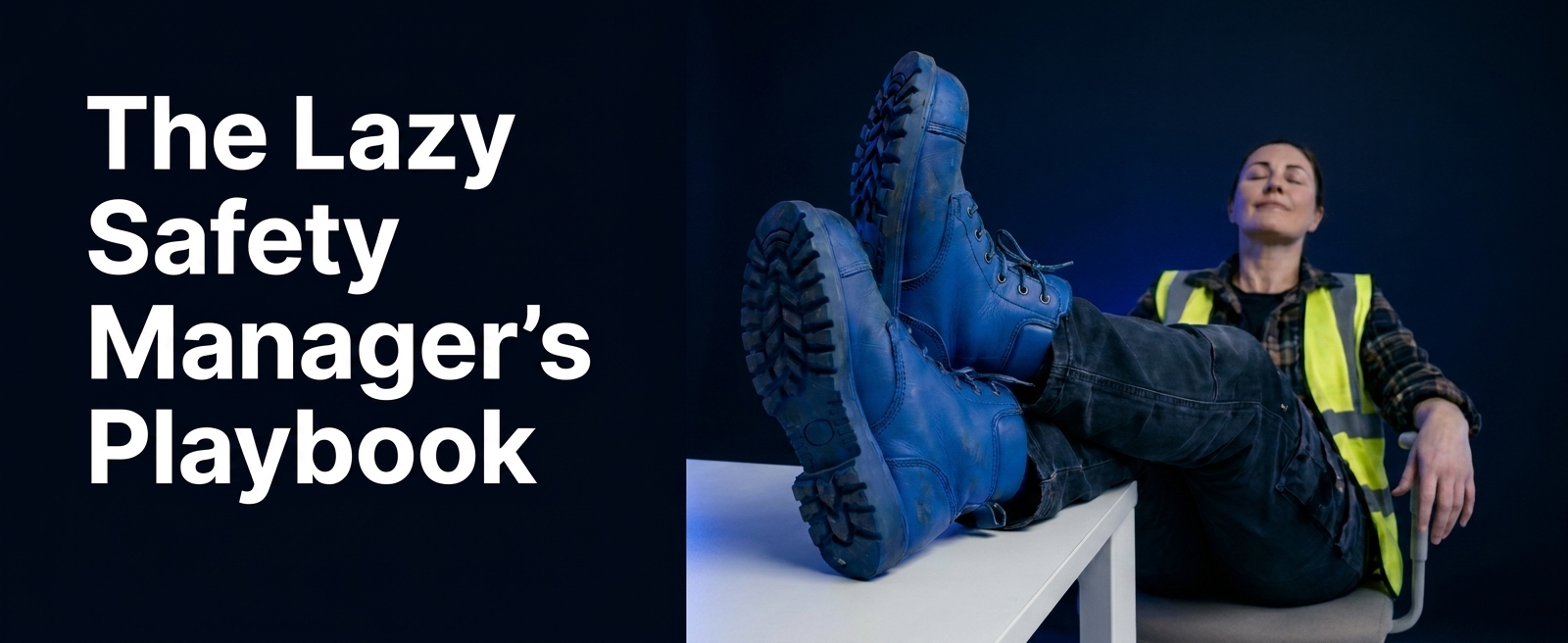
The Lazy Safety
Manager's Playbook
Why the Most Effective Safety Professionals Work Less — and What They Do Instead
Strip away the frameworks and the LinkedIn thought leaders. Safety is one battle: hazards vs. controls. This playbook shows you how to fight it where it counts — and stop fighting everywhere else.
The only battle that matters
Safety is simpler than the industry has made it. Every policy review, every inspection, every risk assessment either contributes to winning the hazards vs. controls battle — or it doesn't. Most safety activity, if we're honest, falls into the second category.
The safety professionals who consistently deliver results aren't the ones working the hardest. They're the ones who figured out early that the battle is the only thing that matters, and ruthlessly stopped doing everything else.
“The battle is simple: Hazards vs. Controls. Everything else is noise.”
The 80% you should stop doing
The Pareto principle applies to safety as brutally as it applies to everything else. Roughly 20% of your hazards are responsible for roughly 80% of your incidents. The playbook names four categories of activity that crowd out the work that actually matters:
- The blanket inspection — Inspecting everything, everywhere, at the same frequency — regardless of whether that area has any meaningful incident history.
- The tick-and-flick risk assessment — Four hundred pieces of equipment, each getting the same level of attention regardless of risk profile. A document that satisfies compliance and changes nothing in the field.
- The annual policy review — Hours spent checking whether documentation is current and correctly formatted. Important, yes — but almost no direct impact on whether controls are actually working.
- Admin — The single biggest consumer of safety professional time and the activity with the least direct connection to the hazard-control battle.
Find out who's winning — your data already knows
The real story is in the free text of your incident data. Every incident contains a signal. SoterAI's Analyze Incident Trends workflow reads your incident data — including free-text fields — and surfaces the patterns that categories always missed.
“You've been categorizing incidents for twenty years so you could analyze them. Now you don't have to.”
Platform data
28,000+
workflows completed on SoterAI in a single month
20,000+
hours saved
Source: SoterAI platform data, April 2025
The 12-month playbook
No complexity. No new frameworks. Just the battle, fought in the right order.
Months 1–2
Find Your 20%
Upload your historical incident data as a CSV, run Analyze Incident Trends, identify your top risks and missing controls.
Months 3–4
Map Your Controls
Process your policies, procedures, and SOPs through Risk Intelligence. Identify the top 3–5 scenarios where the hazard-control gap is most critical.
Months 5–8
Close the Gaps
Work through your priority scenarios. Implement controls, verify them in the field with targeted Hazard Identification, and watch risk scores shift.
Months 9–12
Measure, Report, Move On
Quantify the shift in incident reduction and hours saved. Report to leadership in language they understand: dollars, time, and outcomes.
The permission slip
You don't have to do everything. You never did. The safety professionals who define the next decade won't be the ones who worked the hardest. They'll be the ones who identified which hazards were winning, verified that their controls were real, closed the gaps that mattered, and had the discipline to ignore the rest.
“The lazy safety manager isn't lazy. They've just stopped confusing activity with impact.”
Download the full playbook
Get the complete 10-page guide — including the 12-month implementation playbook and the SoterAI workflow breakdown.